Skylights and Flat Roofs in Massachusetts: Why Installation Details Matter
Skylights and Flat Roofs: Getting the Installation Details Right
A skylight can completely change the way an interior space feels.
Natural light can make a room brighter, more inviting, and visually larger. In homes where wall space or window placement limits natural lighting, a skylight can provide an especially valuable solution.
But installing a skylight means creating an opening in one of the home’s most important weather-protection systems: the roof.
On a flat or low-slope roof, that makes proper installation, flashing, transitions, and water management particularly important.
For homeowners throughout Middlesex County, Worcester County, Norfolk County, and the Greater Boston Area, understanding these details can help prevent a beautiful architectural feature from becoming a source of recurring roofing problems.
Why Skylights Require Special Roofing Attention
A continuous roof surface is relatively straightforward from a water-management perspective.
A skylight interrupts that surface.
The roofing system now needs to transition around:
- The skylight frame
- Corners
- Raised edges
- Roofing membrane
- Flashing components
- Seams and transitions
Each of these areas must work together.
A skylight installation should therefore be considered part of the roofing system—not simply a window installed in the ceiling.
Flat Roofs Change How Water Moves
On a steeply pitched roof, gravity helps move water quickly toward the roof edge.
A flat or low-slope roof behaves differently.
Although a properly designed “flat” roof is not necessarily perfectly level, water moves across it more slowly.
This makes drainage and transitions especially important.
Why This Matters Around Skylights
The skylight creates a raised obstruction in the roof surface.
Water needs to move around that obstruction and continue toward the intended drainage area.
Poorly designed transitions can potentially create areas where water collects or finds a path beneath the roofing system.
Flashing Is Critical
Flashing is used to help manage water where different building components meet.
Around a skylight, the exact flashing strategy depends on factors such as:
- Skylight type
- Roof system
- Roof slope
- Manufacturer specifications
- Existing construction
The goal is not merely to seal the skylight with caulk.
The goal is to integrate it into the roofing system so water is properly managed.
Why Sealant Alone Isn’t a Roofing System
One mistake homeowners sometimes see on older roofs is repeated applications of sealant around a leaking skylight.
Sealants have appropriate uses, but simply applying more material over an unidentified leak is not necessarily a long-term solution.
A skylight leak can originate from:
- Flashing
- Roofing transitions
- Deteriorated materials
- Skylight components
- Condensation
- Nearby roof conditions
The source needs to be identified before determining the appropriate repair.
Common Areas That Require Attention
When evaluating a skylight on a low-slope roof, contractors may examine:
Corners
Corners create transitions where multiple surfaces meet.
Roof-to-Skylight Connections
The roofing system needs to transition correctly to the skylight assembly.
Existing Seams
Low-slope roofing systems often depend heavily on properly installed seams.
Surrounding Drainage
Water should be able to move around the skylight rather than repeatedly collecting nearby.
The Skylight Unit Itself
Not every leak around a skylight originates in the roof. The skylight assembly should also be evaluated.
Skylight Replacement During Roof Replacement
Roof replacement can be an ideal time to evaluate existing skylights.
Why?
Because the surrounding roofing materials are already being removed or replaced.
This provides better access to the skylight transition and allows the roofing system and skylight details to be considered together.
Depending on the condition of the existing skylight, homeowners may consider whether it makes sense to retain or replace it while the roof is already under construction.
Old Skylight vs. New Skylight During Roofing Work
| Consideration | Keep Existing Skylight | Replace During Roofing |
|---|---|---|
| Existing condition | Should be evaluated | New assembly |
| Roofing integration | Must adapt to existing unit | Can coordinate with new roof |
| Age | Existing service life remains | Begins with new product |
| Labor access | Roof already open | Roof already open |
| Future replacement | May require disturbing roof later | Can align projects |
There is no universal answer. The correct decision depends on the actual condition of the skylight and roof.
Condensation Isn’t Always a Roof Leak
Moisture near a skylight does not automatically mean rainwater is entering through the roof.
Under certain indoor conditions, condensation may form on cold surfaces.
Possible contributing factors can include:
- Indoor humidity
- Ventilation
- Temperature differences
- Insulation conditions
A proper evaluation should distinguish between water intrusion and condensation before repairs are recommended.
Real Ronie Construction Project
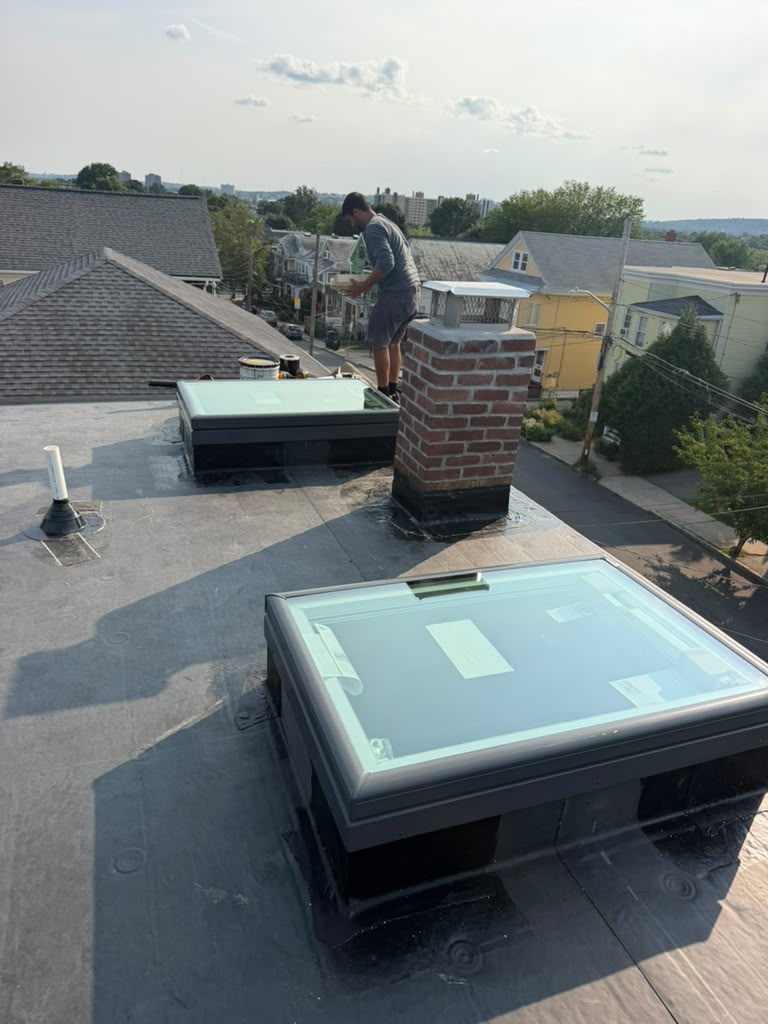
The photographs featured with this article show a real low-slope roofing project completed by Ronie Construction that includes skylights within the roofing area.
These images are valuable because they show something homeowners rarely consider when looking at a finished skylight:
the relationship between the skylight and the surrounding roof.
The roofing surface, skylight perimeter, transitions, drainage, and other penetrations all need to function as part of one system.
This is why roofing craftsmanship becomes especially important around openings.
Skylights in Massachusetts Homes
Massachusetts weather creates changing conditions throughout the year.
Roofing systems may experience:
- Heavy rain
- Snow
- Ice
- Wind
- Heat
- Freezing temperatures
- Repeated temperature changes
Roof penetrations should therefore be designed and maintained with these conditions in mind.
For homeowners in Greater Boston, Middlesex County, Worcester County, and Norfolk County, an existing skylight should be included whenever a roof is professionally evaluated.
Signs a Skylight Area May Need Inspection
Consider professional evaluation if you notice:
- Water stains around the opening
- Bubbling paint
- Discoloration
- Visible roofing deterioration
- Recurring moisture after storms
- Cracked or damaged skylight components
- Problems with surrounding roofing
The visible symptom may not reveal exactly where the problem originates.
Should You Add a Skylight During a Renovation?
Skylights can be an attractive option when homeowners want more natural light.
Before adding one, the project should consider:
- Roof structure
- Roofing system
- Roof slope
- Interior ceiling design
- Water management
- Insulation
- Location
- Electrical or mechanical components
- Local requirements
A skylight should be planned as both an architectural feature and a construction detail.
Why Professional Installation Matters
Roof openings require coordination between the skylight assembly and roofing system.
A contractor needs to understand water movement, flashing, transitions, roofing materials, and the surrounding structure.
Ronie Construction provides roofing and remodeling services throughout Middlesex County, Worcester County, Norfolk County, and Greater Boston, allowing roof penetrations to be evaluated within the context of the complete construction assembly.
Final Thoughts
A skylight can bring beautiful natural light into a home.
But the quality of the installation matters just as much as the skylight itself.
On a flat or low-slope roof, details around flashing, roofing transitions, seams, and drainage deserve particular attention.
When properly planned, the skylight and roofing system should work together—not compete with each other.
FAQs
Can skylights be installed on flat roofs?
Yes. Skylights can be incorporated into many low-slope roofing systems when the product and installation method are appropriate for the application.
Why do skylights sometimes leak?
Moisture can result from flashing problems, roofing deterioration, skylight components, transitions, or even condensation. The source should be professionally evaluated.
Should I replace my skylight when replacing my roof?
It depends on the skylight’s age and condition. Roof replacement is a useful opportunity to evaluate whether retaining or replacing the unit makes sense.
Can caulk fix a leaking skylight?
Sealant may be appropriate for certain details, but simply adding caulk without identifying the source of a leak may not provide a lasting solution.
Do flat-roof skylights need special flashing?
The appropriate installation depends on the skylight and roofing system. Low-slope applications require details designed for the specific roof configuration.
Can skylights improve natural lighting?
Yes. Properly located skylights can introduce significant natural light into areas where conventional windows may be limited.
Planning Roofing Work Around a Skylight?
The details surrounding your skylight are just as important as the skylight itself.
📞 (781) 420-2049
🔗 https://ronieconstruction.com/contact/