Roof Decking in Massachusetts: What Homeowners Should Know Before New Shingles
Why Roof Decking Matters Before New Shingles Go On
When homeowners think about replacing a roof, shingles usually receive most of the attention.
They choose colors, compare products, discuss appearance, and look at warranties.
But beneath those shingles is a component that plays a critical role in the roofing system: the roof deck.
Roof decking—also commonly referred to as sheathing—creates the structural surface over which roofing materials are installed.
Once the finished roof is complete, homeowners normally cannot see it.
That doesn’t make it less important.
In fact, a roof replacement provides one of the best opportunities to evaluate the condition of the deck because removal of the existing roofing exposes areas that may have been hidden for years.
What Is Roof Decking?
Roof decking is the solid surface attached to the roof framing.
Depending on the home’s age and construction, different materials and configurations may be present.
Modern residential construction commonly uses wood structural panels, while older homes may contain different decking systems.
The deck provides the base for roofing components such as:
- Underlayment
- Water-management layers
- Asphalt shingles
- Other roofing materials
If the base is compromised, installing beautiful new shingles does not address the underlying problem.
Why Can’t Contractors Fully Evaluate the Deck From the Ground?
Some roof conditions can be observed before demolition.
But the existing roofing material covers much of the deck.
Once shingles and underlying materials are removed, contractors can directly inspect areas that were previously concealed.
This can reveal:
- Water-damaged wood
- Deteriorated sections
- Soft areas
- Openings
- Previous repairs
- Improper patches
- Loose materials
- Other conditions requiring attention
That is one reason roof replacement estimates may need to account for the possibility of concealed conditions.
What Causes Roof Deck Damage?
Roof decking can deteriorate for several reasons.
Water Intrusion
Water entering through failed roofing or flashing can reach the wood underneath.
Repeated moisture exposure can eventually damage the material.
Flashing Problems
Areas around chimneys, skylights, walls, and roof penetrations require careful water management.
Problems in these areas can allow moisture to reach the deck.
Ventilation or Moisture Conditions
Moisture can also originate from conditions within the attic or building.
This is why roof and attic systems should be considered together rather than as completely unrelated components.
Previous Construction Work
Older roofs may contain repairs or modifications from previous projects.
Some may be perfectly serviceable; others may require correction when exposed.
Signs That Roof Decking May Need Attention
Before removal, homeowners or contractors may notice clues such as:
- Visible sagging
- Repeated roof leaks
- Soft areas
- Interior water staining
- Persistent moisture problems
- Uneven roof surfaces
However, these symptoms do not automatically diagnose damaged decking.
The condition needs to be evaluated directly.
What Happens When Damaged Decking Is Found?
If sections of decking are unsuitable for the new roofing installation, the affected areas may need to be addressed before work continues.
The appropriate solution depends on:
- Type of damage
- Extent of damage
- Existing construction
- Structural conditions
- Roofing system
- Applicable requirements
This stage should happen before the new roofing covers the deck again.
Why Installing Shingles Over a Poor Surface Is a Problem
The finished roofing system needs an appropriate substrate.
An unsuitable deck can potentially contribute to:
- Poor fastening
- Uneven surfaces
- Continued deterioration
- Problems with finished roofing
- Reduced confidence in the installation
Roof replacement should therefore address the condition of the existing system rather than simply improving its appearance.
Roof Deck vs. Underlayment vs. Shingles
These components are sometimes confused.
| Component | Primary Role |
|---|---|
| Roof framing | Supports the roof structure |
| Roof deck/sheathing | Creates the structural installation surface |
| Underlayment | Adds a protective layer above the deck |
| Flashing | Manages water at transitions and penetrations |
| Shingles | Provides the primary exterior weather-shedding surface |
They work together.
No single layer should be expected to compensate for major problems in another.
Why Roof Replacement Is the Right Time to Inspect the Deck
Once the old roof has been removed, the deck is exposed.
This creates an opportunity to evaluate areas that may not be accessible during routine exterior inspections.
It also allows necessary work to happen before expensive new roofing materials are installed.
From a homeowner’s perspective, this is an important part of understanding what they are paying for.
A roofing proposal should not be evaluated solely on:
- Shingle brand
- Shingle color
- Finished appearance
- Lowest price
The preparation underneath matters too.
Real Ronie Construction Project
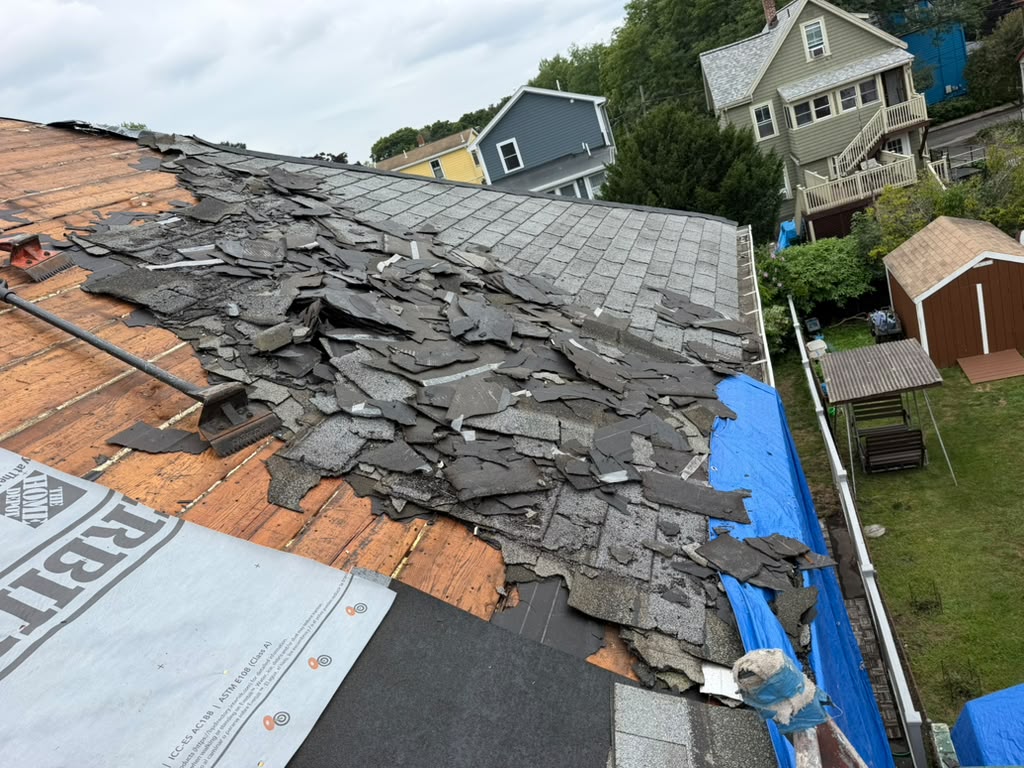
One of the photographs from this Ronie Construction project captures exactly the stage homeowners rarely see: the roof after removal and during preparation.
At this point, the finished shingles are gone and the underlying construction becomes visible.
This is where professional observation becomes especially valuable.
Any necessary work can be identified before the new system conceals the surface again.
Using real project photography is useful because it demonstrates that roofing is a construction process—not simply a finished product.
What Should You Ask Your Roofing Contractor?
Before beginning a roof replacement, homeowners can ask:
Will the existing roof be inspected after removal?
Understand how concealed conditions will be handled.
What happens if damaged decking is found?
Ask how additional work will be documented and priced.
What type of underlayment will be installed?
Understand the complete roofing assembly.
How will flashing areas be addressed?
Ask specifically about chimneys, walls, vents, and skylights if applicable.
Will I be informed about unexpected conditions?
Clear communication can prevent surprises.
Massachusetts Homes and Existing Conditions
Massachusetts has a wide variety of housing stock, including many older homes.
Older properties can contain multiple generations of repairs, renovations, and roofing work.
A contractor replacing a roof in Greater Boston, Middlesex County, Worcester County, or Norfolk County may therefore encounter conditions that could not be fully identified from an exterior visual inspection.
This makes careful removal and evaluation particularly valuable.
Should All Roof Decking Be Replaced During a Roof Replacement?
Not automatically.
Whether decking needs replacement depends on its condition, the roofing system, applicable requirements, and the professional assessment of the existing structure.
Replacing sound material simply because the roof is being replaced may not always be necessary.
Conversely, leaving clearly unsuitable material in place merely to reduce initial project cost can be a poor decision.
The correct approach should be based on actual conditions.
How Roof Decking Affects the Budget
Concealed conditions are one reason homeowners should understand how their roofing contract handles additional work.
Before signing, ask how decking replacement—if needed—is calculated.
A transparent proposal should help explain:
- What is included
- What is considered additional work
- How additional decking is priced
- How approval is handled
This creates a clearer relationship between homeowner and contractor.
Why Experience Matters
Identifying roof deck problems requires more than looking at the finished shingles.
Contractors need to understand roofing systems, wood deterioration, water pathways, flashing, structural conditions, and installation requirements.
Ronie Construction provides roofing as part of its broader construction and remodeling work throughout Middlesex County, Worcester County, Norfolk County, and the Greater Boston Area.
This construction perspective matters when problems extend beyond the visible roofing surface.
Final Thoughts
The roof deck is one of the most important parts of a roof that homeowners almost never see.
Once new shingles are installed, it disappears again.
That makes the period between removing the old roof and installing the new system especially important.
A professional roof replacement should not simply make your home look better from the street.
It should begin with an appropriate surface underneath.
FAQs
What is roof decking?
Roof decking or sheathing is the structural surface installed over roof framing and beneath roofing materials.
How do I know if my roof decking is damaged?
Some signs may be visible before replacement, but the full condition often becomes easier to evaluate after existing roofing materials are removed.
Does damaged roof decking need to be replaced?
Unsuitable or deteriorated areas may need repair or replacement before new roofing is installed. The appropriate solution depends on the specific condition.
Is roof decking the same as underlayment?
No. The deck is the structural installation surface, while underlayment is a protective layer installed above it as part of the roofing assembly.
Is new plywood always required during roof replacement?
No. The need for replacement depends on the condition and suitability of the existing deck and the requirements of the roofing system.
Can roof deck repairs increase the cost of replacement?
Yes. Concealed damage discovered after removal can affect project cost, which is why homeowners should understand how their contractor handles unexpected conditions.
What’s Under Your Roof Matters.
New shingles are only part of a professional roof replacement.
Trust Ronie Construction to evaluate the complete roofing system and give the details underneath the attention they deserve.
📞 (781) 420-2049
🔗 https://ronieconstruction.com/contact/