Flat Roof Replacement in Massachusetts: What Homeowners Should Know
Flat Roof Replacement: What Massachusetts Homeowners Should Know
Not every roof is designed to shed water the same way.
Traditional steep-slope residential roofs commonly use shingles to direct water downward across an angled surface.
Flat and low-slope roofs require a different approach.
Although commonly called “flat roofs,” these systems are typically designed with enough slope and drainage strategy to move water toward designated drainage points.
That makes membrane installation, seams, penetrations, flashing, transitions, and drainage especially important.
For property owners throughout Middlesex County, Worcester County, Norfolk County, and the Greater Boston Area, understanding these differences can help when evaluating an existing flat roof or planning a replacement.
What Is a Flat or Low-Slope Roof?
A flat roof is a common name for a roofing system with a much lower slope than a traditional pitched roof.
These roofs can be found on:
- Residential additions
- Porches
- Garages
- Multifamily properties
- Commercial buildings
- Contemporary homes
- Older urban properties
Because gravity moves water differently across a low-slope surface, these roofs generally rely on roofing systems specifically designed for that application.
Why Regular Asphalt Shingles Aren’t the Whole Answer
Asphalt shingles work by shedding water across overlapping layers on an adequately sloped roof.
Low-slope applications require different considerations.
The roofing system needs to manage water across a surface where runoff may happen more slowly.
This makes the selection of the appropriate roofing system and installation method critical.
Water Management Is the Central Issue
Every roof manages water, but flat roofs make drainage particularly visible.
A properly planned system needs to consider how water reaches:
- Drains
- Gutters
- Scuppers
- Edges
- Other designated drainage points
If water repeatedly remains in unintended areas, the underlying cause should be evaluated.
Simply addressing the visible surface without understanding drainage may not resolve the problem.
Why Flat Roofs Develop Problems
Flat roof issues can result from several conditions.
Aging Roofing Materials
All roofing materials are subject to aging and weather exposure.
Damaged Seams or Transitions
Certain roofing systems depend on carefully executed seams and connections.
Penetrations
Vents, skylights, chimneys, mechanical components, and other penetrations create areas that require special detailing.
Flashing Problems
Roof-to-wall transitions and other changes in surface require appropriate water management.
Drainage Concerns
Blocked or poorly functioning drainage can allow unwanted water accumulation.
Flat Roof Replacement vs. Repair
Not every flat roof problem requires complete replacement.
Repair may make sense when:
- Damage is isolated
- The surrounding roofing system remains serviceable
- The source of the problem can be clearly identified
- The roof has not reached the end of its useful service life
Replacement may become more appropriate when:
- Problems are widespread
- Leaks repeatedly return
- The system is significantly deteriorated
- Multiple repairs have already been attempted
- Existing conditions make continued patching impractical
A professional evaluation is necessary to determine which approach makes sense.
What Happens During Flat Roof Replacement?
The exact process varies depending on the roof and system, but a project can involve:
1. Existing Roof Evaluation
The contractor evaluates visible conditions, drainage, penetrations, edges, and transitions.
2. Removal or Preparation
Existing roofing materials may need removal or preparation according to the selected system and project requirements.
3. Substrate Inspection
Underlying surfaces are evaluated for deterioration or other conditions.
4. Surface Preparation
The roof is prepared for the new roofing system.
5. Roofing Installation
The appropriate low-slope roofing material is installed according to system requirements.
6. Detail Work
Penetrations, flashing, edges, drains, skylights, and other critical areas receive specific attention.
7. Final Review
The finished system and surrounding areas are reviewed.
Flat Roof vs. Shingle Roof
| Feature | Flat / Low-Slope Roof | Pitched Shingle Roof |
|---|---|---|
| Roof angle | Low | Moderate to steep |
| Typical water movement | Controlled drainage | Gravity-driven shedding |
| Surface system | Low-slope roofing system | Overlapping shingles |
| Seams/details | Particularly important | Important |
| Penetrations | Require specialized detailing | Require flashing/detailing |
| Drainage | Central design consideration | Roof slope naturally assists |
| Installation approach | System-specific | Shingle-system-specific |
Neither system is inherently “better.”
They serve different roof designs.
Skylights and Flat Roofs
Some of the real Ronie Construction project photographs show skylights incorporated into a low-slope roofing area.
Skylights create an interruption in the continuous roofing surface.
That means the surrounding details must manage water carefully.
The roof system, skylight assembly, flashing strategy, and transitions all need to work together.
This is one reason skylights will receive their own dedicated article in this series rather than being treated as a minor footnote.
Chimneys and Other Roof Penetrations
Chimneys are another important detail.
Whenever a roof meets a vertical structure, the transition needs to prevent water from entering the building assembly.
The same principle applies to other penetrations.
Homeowners evaluating a flat roof should pay particular attention to areas around:
- Chimneys
- Skylights
- Vents
- Walls
- Mechanical equipment
- Drains
Many roofing problems originate at transitions rather than in the center of a large uninterrupted roofing surface.
Flat Roof Drainage in Massachusetts
Massachusetts properties experience rain, snow, freezing temperatures, and seasonal temperature changes.
Water management therefore deserves careful attention.
Homeowners should keep roof drainage areas clear and watch for conditions such as:
- Repeated standing water
- Clogged drainage
- Visible membrane deterioration
- Interior staining
- Problems around penetrations
Visible symptoms do not always identify the exact source of a leak, so professional inspection may be needed.
Real Ronie Construction Project
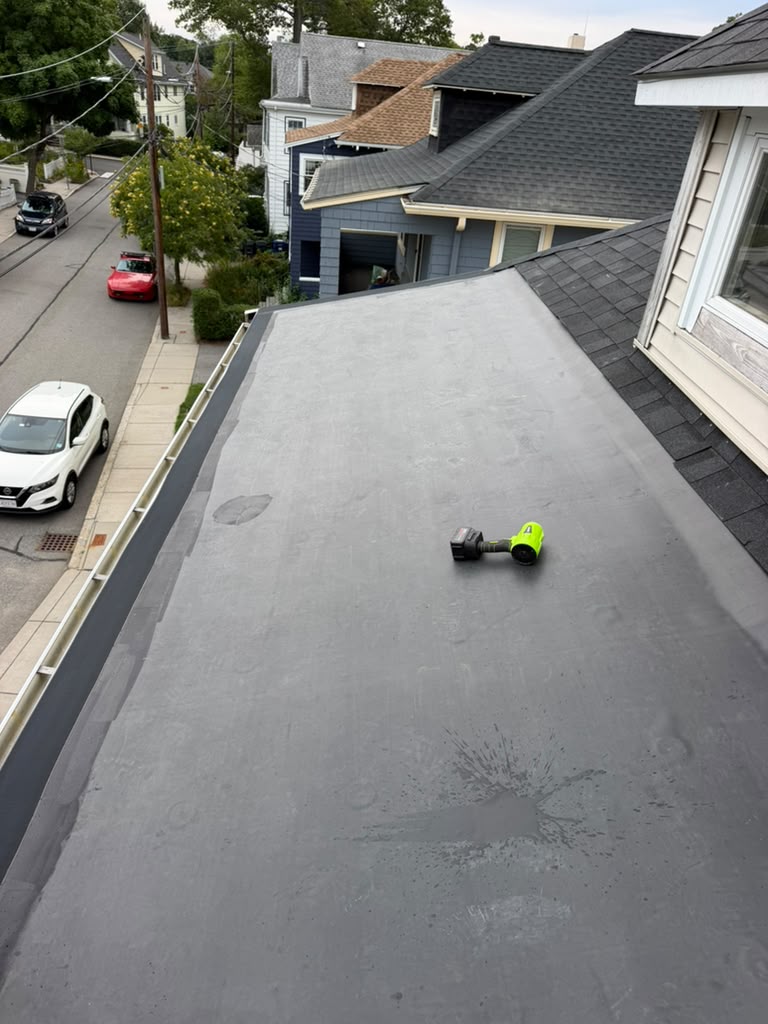
The images accompanying this article show a real low-slope roofing project performed by Ronie Construction.
The photographs are particularly useful because they show more than a generic finished roof.
They reveal several important characteristics of low-slope roofing, including:
- Large continuous roof surfaces
- Transitions
- Penetrations
- Skylight areas
- Chimney details
- Finished roofing installation
This is the kind of work that illustrates why flat roofing should be treated as a specialized roofing system rather than approached as a conventional shingle roof with less pitch.
Questions to Ask Before Replacing a Flat Roof
Homeowners should consider asking:
- What roofing system is appropriate for this roof?
- What is the condition of the existing substrate?
- How does the roof currently drain?
- Are there signs of standing water?
- How will skylights and penetrations be handled?
- What flashing details require attention?
- What happens if concealed damage is discovered?
- What maintenance will the new system require?
These questions help shift the conversation from “How much is a flat roof?” to the more useful question:
“What does this specific roof need?”
Maintenance After Installation
Even a newly installed roof should be monitored.
Periodic visual inspection can help identify:
- Debris
- Drainage blockages
- Physical damage
- Problems around penetrations
- Changes in seams or edges
- Other visible concerns
It is particularly useful to inspect roofing systems after severe weather or when interior moisture symptoms appear.
Why Flat Roofing Requires Professional Experience
Low-slope roofing involves specialized materials, water-management strategies, penetrations, transitions, and drainage considerations.
The contractor needs to evaluate the complete system rather than focusing only on the visible roofing surface.
Ronie Construction performs roofing and construction work throughout Middlesex County, Worcester County, Norfolk County, and the Greater Boston Area, including projects involving both pitched and low-slope roofing conditions.
Final Thoughts
Flat roofs are not simply traditional roofs without the pitch.
They are roofing systems with their own installation, drainage, flashing, and maintenance considerations.
A successful flat roof replacement begins with understanding:
- The existing roof
- The substrate
- Water movement
- Penetrations
- Flashing
- Drainage
- The appropriate roofing system
When those details are handled correctly, the finished roof becomes the visible result of a much more comprehensive construction process.
FAQs
Is a flat roof completely flat?
Typically, roofs described as flat still incorporate slope or drainage strategies to help manage water.
Can asphalt shingles be used on any low-slope roof?
Roofing materials have slope limitations and installation requirements. The appropriate system should be selected according to the roof design, product requirements, and applicable standards.
Should standing water on a flat roof be ignored?
Persistent standing water should be evaluated because it may indicate a drainage or surface condition requiring attention.
Can a leaking flat roof be repaired instead of replaced?
Sometimes. The appropriate solution depends on the age, condition, extent of damage, and overall serviceability of the existing roofing system.
Why are skylights important during flat roof replacement?
Skylights interrupt the continuous roofing surface and require appropriate detailing and water management around the opening.
How often should a flat roof be inspected?
Inspection needs vary by roof and conditions, but periodic inspections and checks after significant weather events can help identify visible problems before they become more extensive.
Does Your Flat Roof Need Professional Attention?
Leaks, drainage concerns, aging materials, and problems around skylights or other penetrations deserve more than another temporary patch.
Talk to Ronie Construction about evaluating your flat or low-slope roofing system.
📞 (781) 420-2049
🔗 https://ronieconstruction.com/contact/