Roof Flashing Around Chimneys: Why Proper Installation Matters in Massachusetts
Roof Flashing Around Chimneys: A Small Detail That Prevents Big Problems
A chimney creates one of the most challenging transitions on a roof.
The roofing surface is designed to move water downward and away from the home. A chimney interrupts that surface with a vertical structure.
The point where those two components meet needs to be carefully managed.
That’s where roof flashing becomes critical.
For homeowners in Middlesex County, Worcester County, Norfolk County, and the Greater Boston Area, understanding chimney flashing can help explain why leaks sometimes develop even when the majority of the roof appears to be in good condition.
What Is Roof Flashing?
Flashing is material installed at roof transitions and penetrations to help direct water away from vulnerable areas.
It is commonly found around:
- Chimneys
- Skylights
- Roof-to-wall intersections
- Vent pipes
- Dormers
- Valleys
- Other penetrations
Flashing is not simply decorative trim.
It forms part of the roof’s water-management strategy.
Why Chimneys Are Vulnerable Areas
Think about how rain moves down a roof.
Across an uninterrupted surface, water generally continues toward the roof edge.
A chimney blocks that path.
Water must now move around:
- The upper side of the chimney
- Both sidewalls
- Lower transitions
- Corners
These intersections need to direct water back onto the roofing surface rather than allowing it to enter behind roofing materials.
Why Flashing Details Matter
The exact flashing configuration varies according to the roof, chimney, roofing material, slope, and existing construction.
Depending on the application, the system may involve several pieces working together.
The important point for homeowners is simple:
Flashing should work as a system.
Applying surface sealant over a poorly designed transition is not necessarily equivalent to correcting the underlying detail.
Why Roof Leaks Often Appear Around Chimneys
Chimneys combine several conditions that can make water intrusion more likely:
- A large roof penetration
- Multiple corners
- Vertical masonry
- Roofing transitions
- Exposure to weather
- Aging materials
Problems may also develop over time as materials deteriorate or previous repairs fail.
Signs of a Potential Chimney Flashing Problem
Homeowners may notice:
- Ceiling stains near the chimney
- Moisture in the attic
- Discoloration
- Peeling paint
- Damp masonry
- Visible gaps around roof transitions
- Repeated leakage during storms
However, these symptoms do not automatically prove the flashing is responsible.
Water can travel before becoming visible indoors.
Professional evaluation is important.
Flashing vs. Sealant
This distinction matters.
| Flashing System | Surface Sealant |
|---|---|
| Helps physically direct water | Helps seal specific joints |
| Integrated with roof assembly | Typically applied to a surface |
| Designed around transitions | Has specific limited applications |
| Part of water-management strategy | May complement proper detailing |
| Should address water pathways | Should not substitute for failed construction |
Sealant isn’t inherently bad.
The problem occurs when it is used repeatedly to cover a condition that requires a more complete repair.
Chimney Flashing During Roof Replacement
A roof replacement provides an important opportunity to evaluate chimney transitions.
Once surrounding roofing materials are removed, contractors may have better access to areas that were previously concealed.
This makes it possible to evaluate:
- Existing flashing
- Surrounding decking
- Roofing transitions
- Previous repairs
- Visible moisture-related damage
New roofing should not simply cover an unresolved problem.
What About the Chimney Itself?
Not every leak near a chimney originates in the roof flashing.
The chimney may also have conditions involving:
- Masonry
- Mortar joints
- Caps
- Crowns
- Other components
This is why diagnosis matters.
The location of an interior stain does not always identify the actual entry point.
Flat Roofs and Chimney Transitions
Chimney details become particularly interesting on low-slope roofs.
Because water moves more slowly across these surfaces, roof-to-chimney transitions require careful attention.
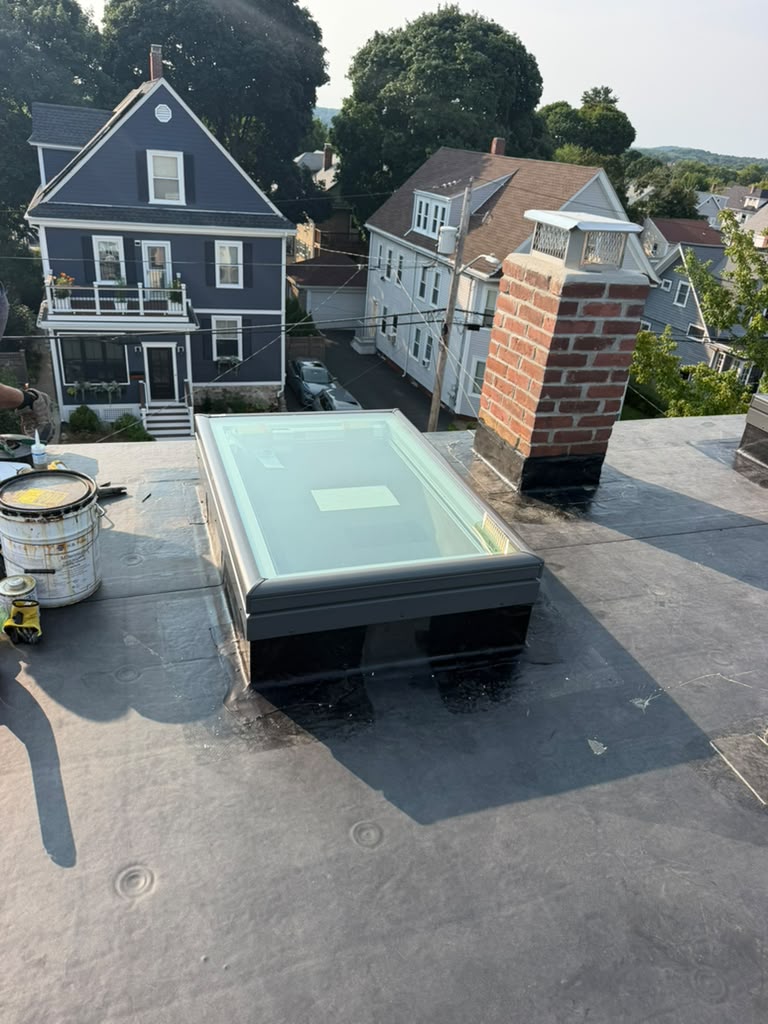
Several of the Ronie Construction project photographs used in this roofing series show exactly this relationship: a low-slope roofing surface meeting a vertical chimney structure.
This gives homeowners a real-world example of why roofing is often about details and transitions, not just large roof surfaces.
Real Ronie Construction Project
The photographs accompanying this article show an actual Ronie Construction roofing project featuring a chimney within the roof system.
Rather than using stock photography, these images allow homeowners to see the actual relationship between:
roof surface → chimney → transition → surrounding roofing.
This is an important part of professional roofing work.
Large uninterrupted roof areas often attract the most attention, but penetrations and transitions deserve equal care.
Why Massachusetts Weather Matters
Massachusetts roofs encounter changing conditions throughout the year.
These can include:
- Rain
- Snow
- Ice
- Freeze-thaw cycles
- Wind
- Summer heat
Different materials can expand, contract, and age over time.
Regular roof evaluation can therefore be particularly valuable around vulnerable transitions.
When Should Chimney Flashing Be Inspected?
Consider having the area evaluated:
- During roof replacement
- When purchasing an older property
- After recurring leaks
- After severe weather
- When visible deterioration appears
- When roofing around the chimney is being repaired
Addressing the cause early can help prevent moisture from affecting surrounding building materials.
Can Chimney Flashing Be Repaired Without Replacing the Entire Roof?
In some situations, yes.
If the surrounding roofing remains serviceable and the problem is localized, a targeted repair may be possible.
In other cases, the flashing issue may be part of broader roof deterioration.
The appropriate solution depends on actual conditions.
Questions to Ask Your Roofing Contractor
When chimney work is involved, homeowners can ask:
- What condition is the existing flashing in?
- Is there evidence of previous repairs?
- Is surrounding decking in good condition?
- How will water be directed around the chimney?
- Does the chimney itself show visible concerns?
- How will the new roof integrate with this area?
These questions can help homeowners understand the project beyond the finished appearance.
Why Professional Roofing Details Matter
Roofing requires understanding how water moves across and around building components.
Chimneys, skylights, walls, and other penetrations create conditions that demand careful installation.
Ronie Construction provides roofing and construction services throughout Greater Boston, Middlesex County, Worcester County, and Norfolk County, with experience handling the broader building conditions that can be encountered during roof work.
Final Thoughts
A chimney may occupy only a small portion of your roof, but the surrounding transition can have a major impact on water management.
Good roofing is not just about covering large surfaces.
It’s about getting the details right.
When replacing or repairing a roof, chimney flashing deserves the same level of attention as the shingles or roofing membrane surrounding it.
FAQs
What is chimney flashing?
Chimney flashing is part of the roof’s water-management system where the roofing surface meets the chimney.
Can damaged chimney flashing cause a roof leak?
Yes. Problems around the roof-to-chimney transition can allow water intrusion, although professional evaluation is necessary to identify the actual source.
Can flashing be repaired without replacing the roof?
Sometimes. It depends on the condition of the surrounding roof and the extent of the problem.
Is caulk enough to repair chimney flashing?
Sealant can have appropriate uses, but applying caulk alone may not correct an improperly constructed or deteriorated flashing system.
Should chimney flashing be checked during roof replacement?
Yes. Roof replacement provides an excellent opportunity to inspect and properly integrate the chimney transition with the new roofing system.
Could the chimney itself be causing the leak?
Yes. Masonry and other chimney components can also contribute to moisture problems, which is why accurate diagnosis matters.
Seeing Water Stains Near Your Chimney?
Don’t assume another layer of sealant will solve the problem.
👉 Ronie Construction can evaluate the roof, flashing, and surrounding conditions to help identify the right solution.
📞 (781) 420-2049
🔗 https://ronieconstruction.com/contact/